
Perry County Civil Docket Searches
Know your hearing date? Begin with the official Perry Search Docket. Pick the setting date. Add a last name, or leave the name blank to pull the full docket for that day. The portal itself cautions that electronic lists can miss cases. For the full timeline of a case, AlacourtACCESS is the better tool. A $9.99 name search comes with one case detail of your choosing. An exact case-number search includes that detail at the same base price. Images carry an added charge.
Before paying for anything, confirm the court, division, parties, and case type. If a search comes back empty or cloudy, call the Perry County Circuit Clerk at 334-683-6106. You can also view an open record at the clerk office, or send in the local copy and search form. That form may be mailed or hand-delivered, and it asks for seven working days.
- Choose Circuit, District, small claims, or another custodian.
- Search the date list or AlacourtACCESS.
- Match the county, parties, division, and case type.
- Read the Case Action Summary in date order.
- Request a named document or certified copy from the clerk.
Note: AlaFile accepts filings and sends notices; it is not the anonymous public Perry County civil docket search.
Perry County Civil Docket Divisions
Money and remedy decide where a Perry County case belongs. Circuit Court alone handles civil claims above $20,000. It shares jurisdiction with District Court above $6,000. District civil work runs from $6,000.01 through $20,000. Small Claims covers up to $6,000 with no jury. Unlawful detainer can fall under either District or Circuit jurisdiction. Anyone seeking injunctive relief files in Circuit Court.
The official Perry Circuit civil page spells out the higher-value division. It also explains how filing works there.
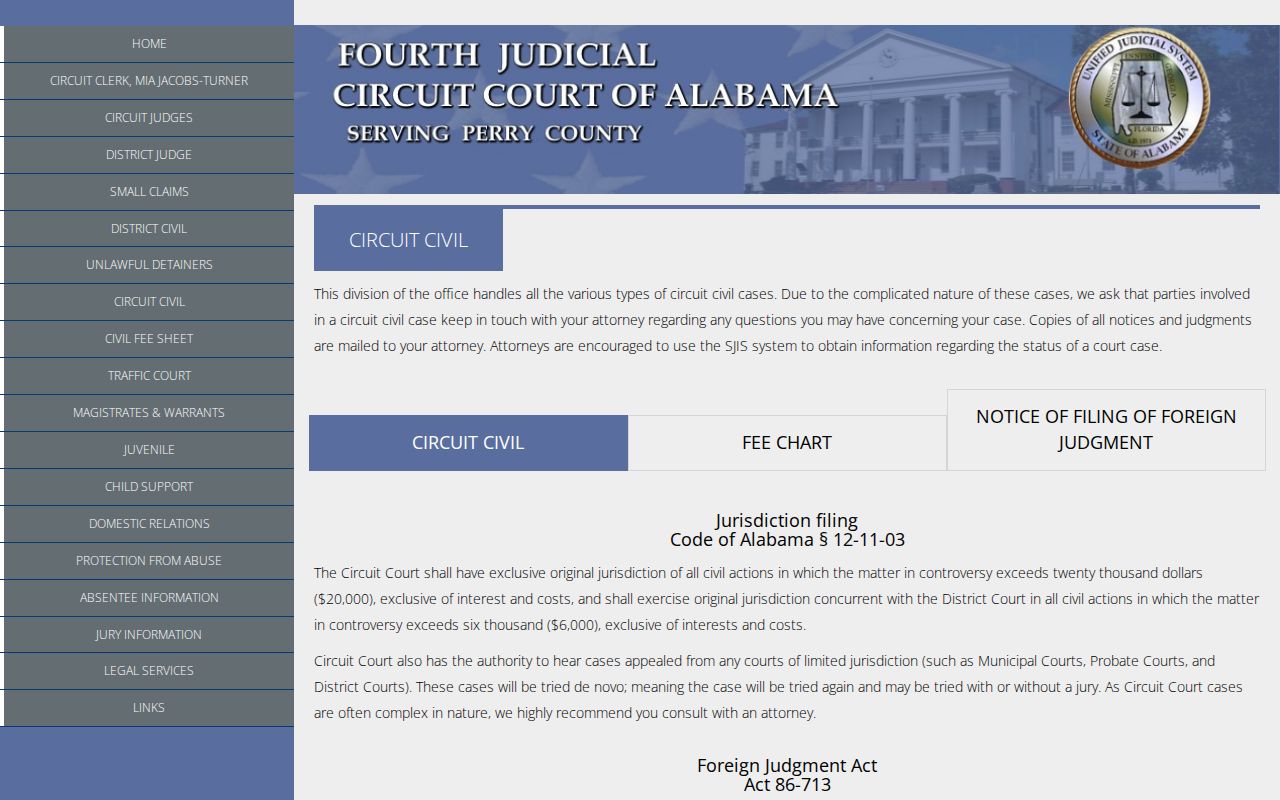
Reading that page makes it easier to tell a Circuit docket apart from a lower-value District file.
The Perry District civil page walks through filing, service, the answer, appeal, and collection steps in the lower division.
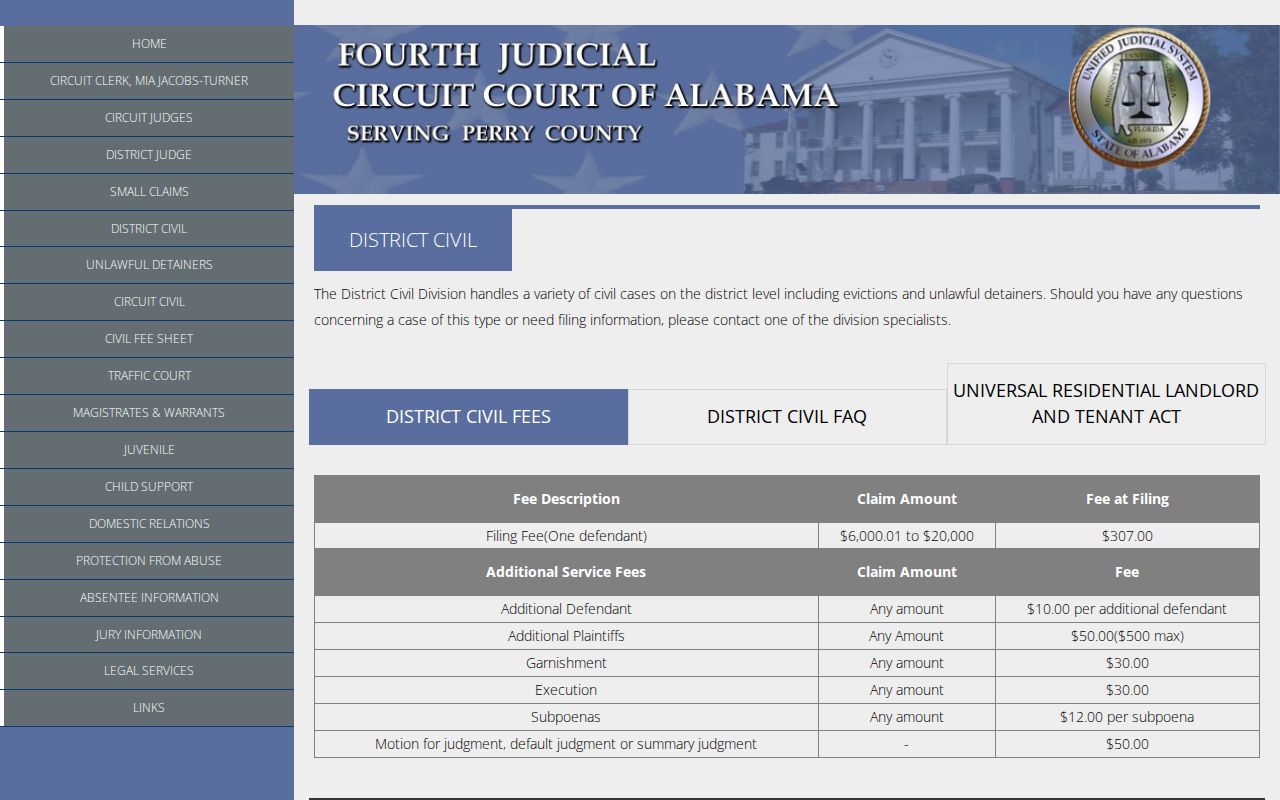
Put the two official sources side by side and one lesson stands out. A docket search should begin with jurisdiction, not with the assumption that every civil matter rides the same track.
Quick answer: Up to $6,000 points to Small Claims, $6,000.01 through $20,000 points to District civil, and claims above $20,000 fall within Circuit Court's exclusive original jurisdiction.
Civil Dockets: What They Show
Think of a Perry County civil Case Action Summary as an event index. It is not the text of each filing. It names the parties and their roles. It tracks the complaint, shows when service issued and returned, and records answers and counterclaims. Motions and settings get listed too. Signed orders, judgment, enforcement, and appeal all appear in time. AlacourtACCESS also advertises financial information, costs, and any available attachments.
| Case identity | Case number, court, division, caption, and type. |
|---|---|
| Parties | Plaintiff, defendant, petitioner, or respondent roles. |
| Service | Issuance and return of sheriff or certified-mail process. |
| Filings | Complaint, answer, counterclaim, motion, or notice. |
| Settings | Trial, motion, status, and continued hearing dates. |
| Result | Signed orders, judgment, dismissal, enforcement, or appeal. |
The public pages stop short of showing Perry's exact civil case-number mask, cause-of-action fields, status menu, or portal code list. Don't guess those details. Take the number from a court notice and confirm it with the clerk.
Perry County Small-Claims Docket
A small-claims case starts with a statement of claim. The clerk assigns the number and arranges service by sheriff or certified mail. The defendant then has fourteen days to answer. When an answer arrives, the local court page says trial usually lands about six to eight weeks after receipt. When nothing arrives, the claimant may seek default with the required proof. Remember that a default request is not the signed judgment itself.
The Perry small-claims page lays out this local filing and hearing sequence.
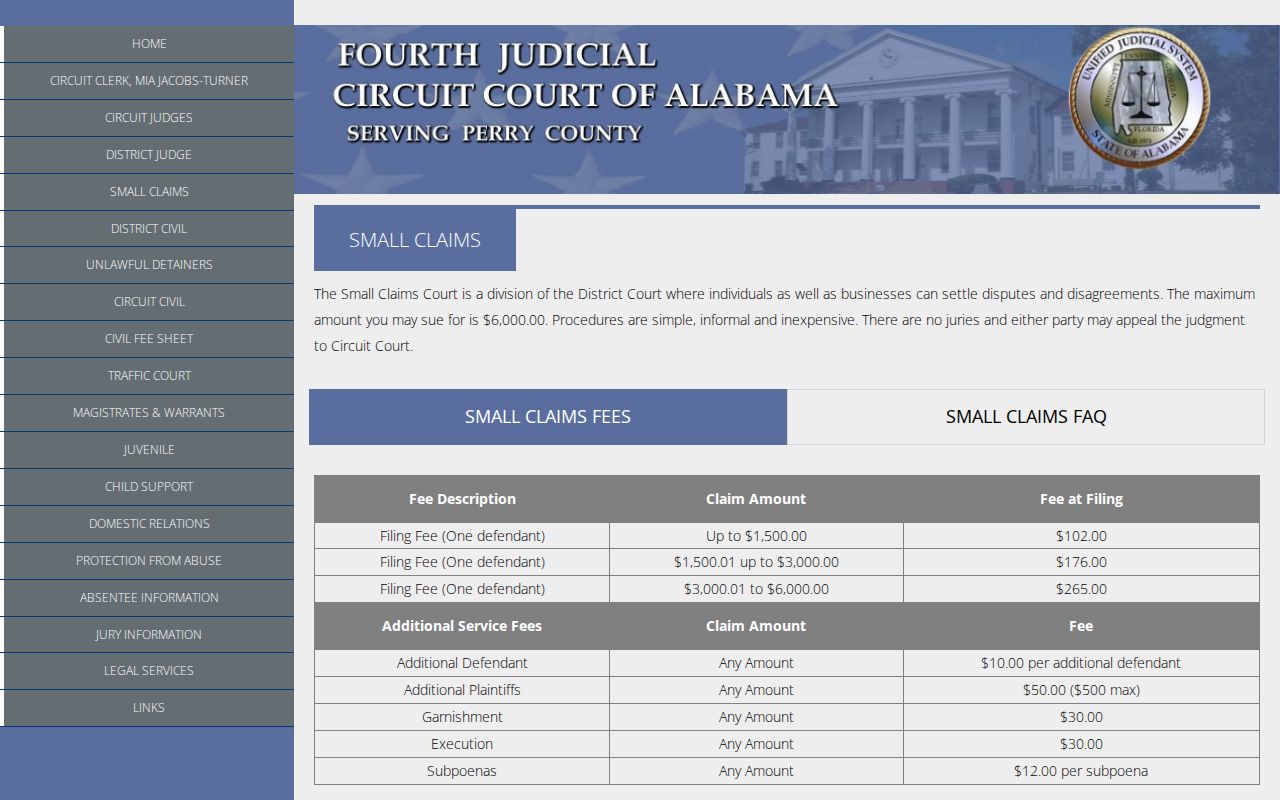
That timing explains a quiet docket after service. The next event may hinge on the answer deadline and trial scheduling rather than a lost filing.
Perry small-claims flow: Claim › Case number › Service › Answer or default request › Trial › Judgment › Collection or appeal.
What Cases Fill the Civil Docket
The Perry County Circuit Clerk holds a broad range of civil state-trial records. Circuit civil covers contracts, torts, condemnations, workers' compensation, and claims within its jurisdiction. District civil handles its lower dollar range. Small claims offers a simpler route. Domestic relations and child support are state-court records as well, though access to a filing can depend on sealing, protected data, or the nature of the material.
- Contract, debt, and other money claims
- Tort, property, condemnation, and workers' compensation matters
- Small claims and District civil cases
- Unlawful detainer proceedings
- Domestic-relations and child-support cases where public
- Post-judgment garnishment and execution activity
Estates, wills, and guardianships live with the separate Perry County Probate Office instead. A District, Municipal, or limited Probate decision can also spawn a new Circuit proceeding through a de novo appeal, meaning a fresh trial rather than a review of the lower record alone.
Perry County Civil Orders Matter
A civil docket often shows a motion before it shows the court's decision. A motion is just a request. It is not a signed order. A setting is not a judgment either. A default request is not always the final default judgment. A closed status says nothing about whether a money judgment was paid. Read forward through the Case Action Summary. Look there for the later ruling, judgment, satisfaction, garnishment, execution, or appeal activity.
Handle service entries with the same care. Perry District Court says the clerk mails a computer printout giving the service date. The court will not check service by phone. That mailed notice can show when the answer period began. Still read the return-of-service entry beside any later answer, default request, or order. Each records a distinct step.
- Motion
- A request asking the judge to rule.
- Order
- The judge's direction or decision.
- Judgment
- The court's final or enforceable civil determination.
- Garnishment
- Post-judgment process aimed at funds or property held by another.
- De novo
- A new trial in Circuit Court after appeal from a lower court.
The Perry domestic-relations page gives a direct route for a certified divorce decree.
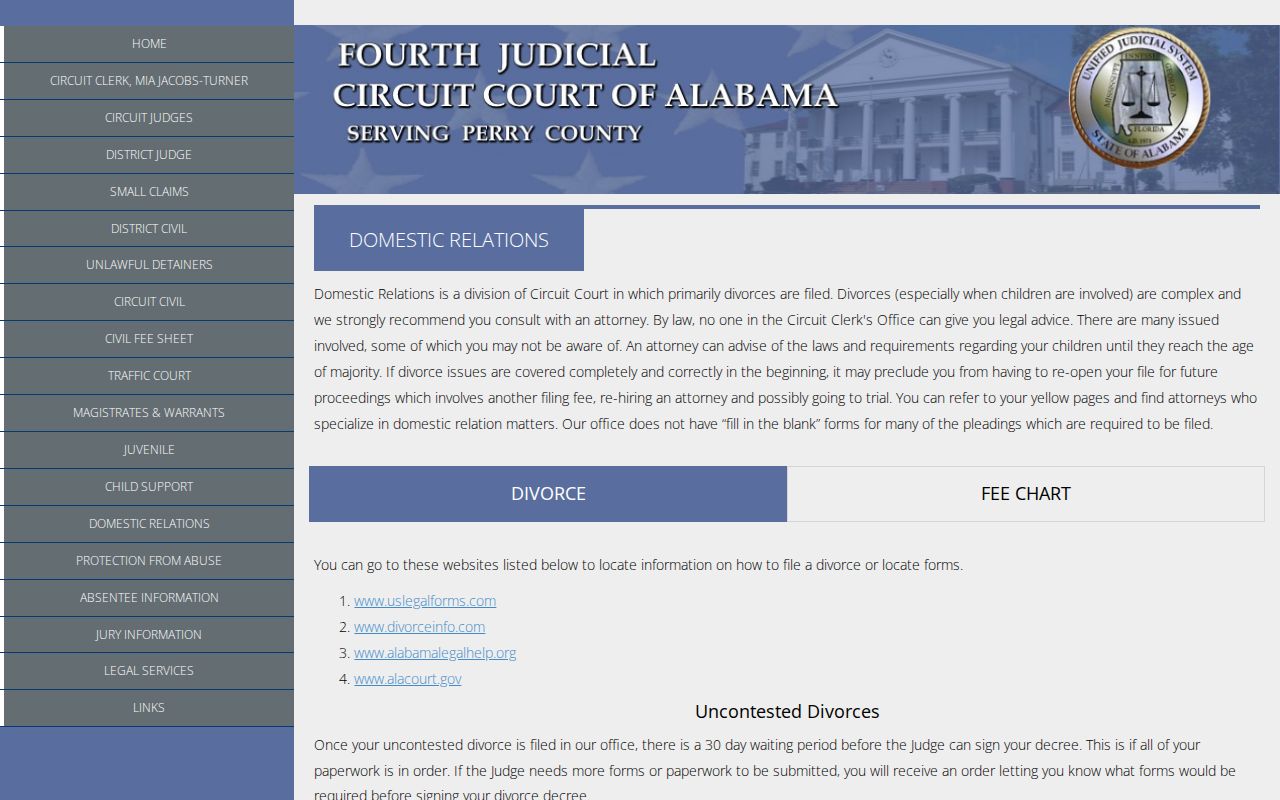
This is a good example of asking for the final signed record rather than a complete file. When one decree answers the question, that is all you need to order.
Hearings on the Civil Docket
Perry County civil dockets carry motion hearings, status dates, and trials. They also cover enforcement matters that follow a judgment. Always work from the newest signed notice or order first. Check it against the Perry date docket. Also check the setting dates in the Case Action Summary. When a case is continued, the old date stays in the chronology. Do not mistake it for the hearing still standing. A scheduling order can pile up several deadlines and events at once. Only the current order still controls the case, and the court record confirms it. Perry posts no detailed monthly civil calendar. Instead, rely on the served or mailed notice first. The date docket, paid case detail, and clerk confirmation complete the chain. If sources disagree, call the Circuit Clerk. For a fuller date workflow, see the Perry County court schedule page. It covers how resets stay visible after a new setting is entered.
Perry County Civil Detainer Clock
Unlawful detainer moves fast in Perry County. It runs from filing through service, response, setting, judgment, and possible appeal. The appeal window is especially tight. Perry County allows seven days to appeal this case type. Ordinary District civil judgments get fourteen days. That short clock makes the judgment date and the current docket entry critical to track. The official Perry unlawful-detainer page lays out the local procedure and deadlines.
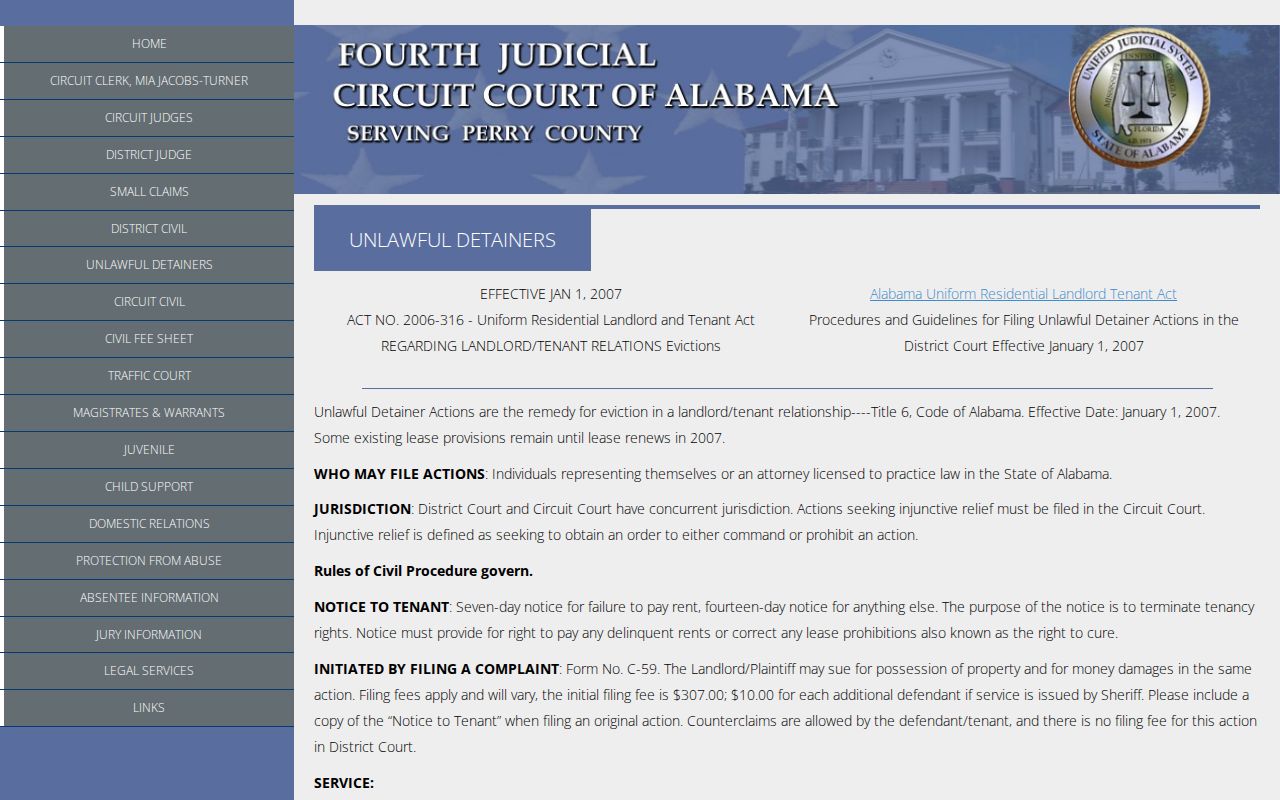
The Perry page also shows why this docket is not a routine debt claim. Watch for a new Circuit case number. If an appeal is filed, the de novo proceeding runs as a separate track in Circuit.
Note: Confirm a live deadline from the filed judgment and clerk; a general web summary cannot replace the controlling court record.
Who Can See Civil Dockets
Many Perry County civil docket entries are open. Access has limits, though. Alabama's 2025 court-record privacy and confidentiality rules draw a line between free viewing of District and Circuit electronic dockets at the clerk office and paid subscriber access from afar. Alabama Rule of Civil Procedure 5.1 requires certain personal data to be protected. Sealed filings do not open up. Nor do juvenile material, adoption records, protected identifiers, or some family content, just because the rest of the docket is public.
Access rule: Use the public summary to follow filings, settings, and rulings. Ask the clerk about a restricted item, and do not try to defeat a seal or redaction.
The public-writing right in Alabama Code section 36-12-40 is broad. It still yields to statutory exceptions and the judiciary's own record rules. The Circuit Clerk can certify an available record. A portal image or snapshot is not certification. It may lag behind the latest event.
Perry County Civil Record Costs
Filing fees and copy fees answer two different questions in Perry County. Filing starts a court action. Copy fees apply when you retrieve an existing file. The local civil pages publish tiered filing charges. Copies work on a sliding scale. The Perry copy form charges $25 for pages one through twenty, fifty cents for each extra page, and $5 for each certification. A closed-case, register, or archive search costs $25. A paper history search costs the same. The Perry civil fee sheet gathers the local filing amounts.
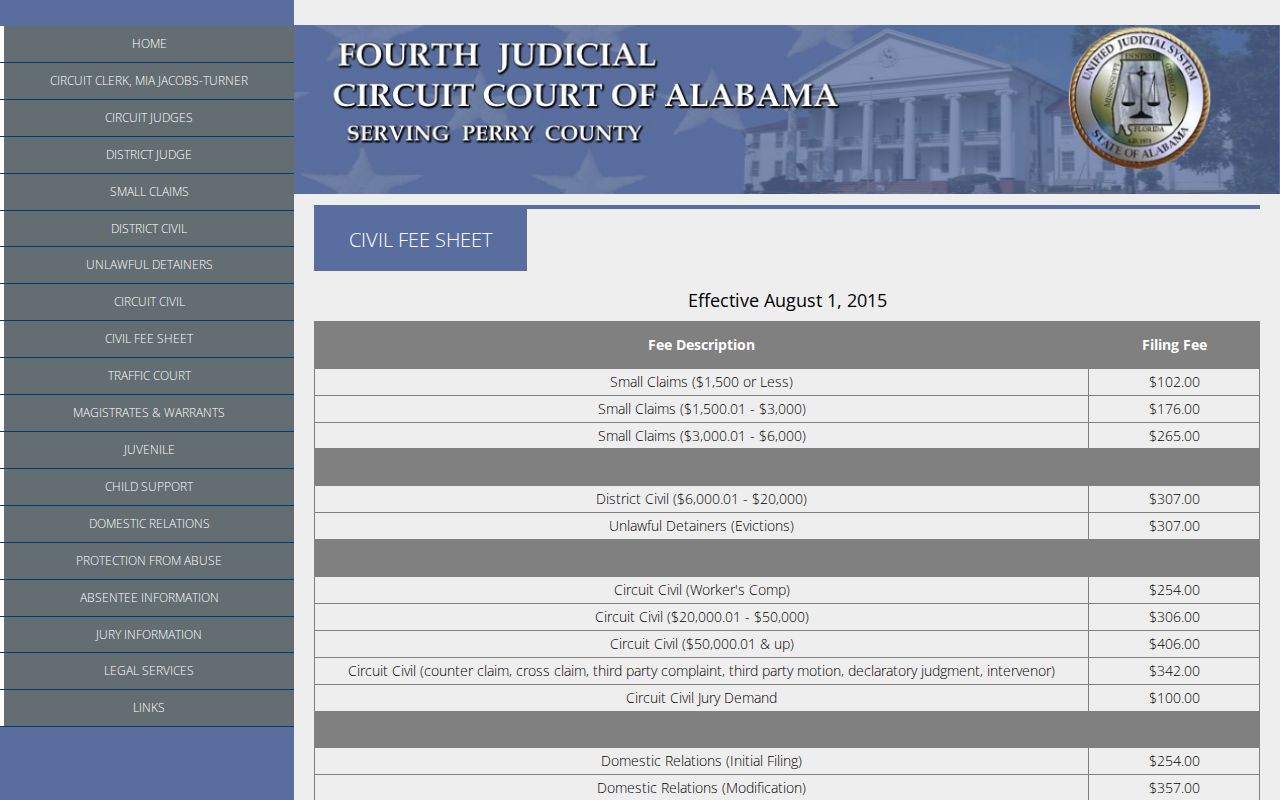
These figures describe the docket division's costs. Do not confuse them with the price of a Case Action Summary, judgment, or certified copy.
| Record product | Published amount |
|---|---|
| Local copy, pages 1 through 20 | $25.00 |
| Each added page | $0.50 |
| Each certification | $5.00 |
| Closed case, register, or archive search | $25.00 |
| AlacourtACCESS base case detail | $9.99 |
| Online image, first 20 pages | $5.00 |
Pick the narrowest item on the form. The last signed order, judgment, garnishment, execution, or Case Action Summary all qualify. A full file is bigger and slower. Fees are due on delivery, personal checks are refused, and the search fee applies even if no result is found.